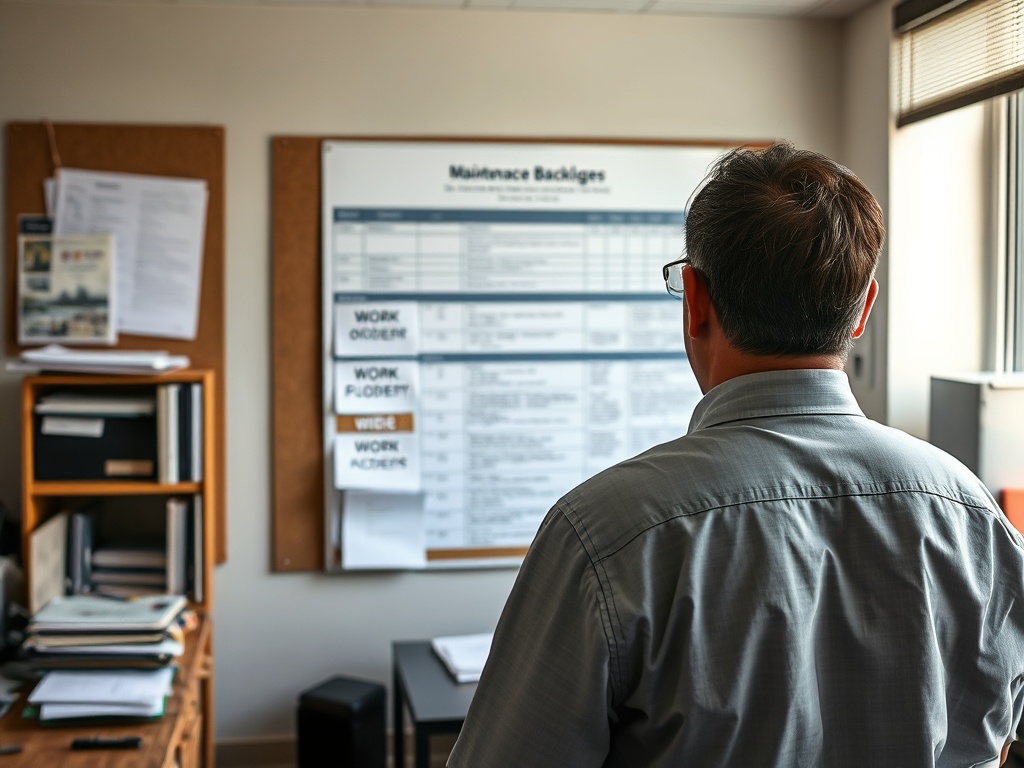

When budgets are tight, maintenance backlog decisions should be made through a documented priority system. The most defensible approach ranks work by safety risk, regulatory exposure, operational impact, asset condition, cost of delay, and the effect on occupants or tenants.
Budget-pressure triage in plain terms
- A maintenance backlog should be ranked by risk, compliance, asset criticality, occupant impact, and timing, not by who complains the loudest.
- Small repairs still matter, but limited funds should first protect safety, code obligations, essential operations, and assets that are expensive to lose.
Define the backlog before ranking it
A backlog is not simply a long to-do list. It should separate corrective repairs, preventive maintenance, deferred capital work, inspection findings, tenant requests, warranty items, code-related deficiencies, and recurring nuisance issues. Combining all of those into one list makes the loudest or easiest tasks look more urgent than they are.
Start by giving each item a short description, location, asset name, source of request, date opened, observed consequence, and responsible party. Link the item to a building asset if possible. ISO 55000 frames asset management around realizing value from assets across their life cycle, which is a useful mindset for facilities teams that need to justify why one repair deserves funding before another.
Sort by consequence, not convenience
A low-cost repair can be urgent if it protects people or prevents a larger failure. A high-cost repair may be deferrable if the risk is low and monitoring is reliable. The score should reflect consequence and likelihood, not only price.
Life safety, fire protection, emergency power, electrical hazards, blocked egress, active leaks, structural concerns, and environmental health risks usually deserve immediate review by qualified professionals. Cosmetic issues, comfort complaints, or noncritical finish repairs may still matter, but they should be evaluated in relation to use, tenant impact, contractual duties, and deterioration risk.
A simple priority matrix for facilities teams
| Priority tier | Typical backlog item | Budget action |
|---|---|---|
| Tier 1: immediate risk | Unsafe condition, life-safety deficiency, active water entry, critical equipment fault. | Escalate, fund, or isolate the hazard; document interim controls. |
| Tier 2: high consequence | Equipment or envelope issue that may disrupt operations or cause larger damage. | Schedule soon, bundle related work, and track cost of delay. |
| Tier 3: planned correction | Known deficiency with stable condition and limited occupant impact. | Place in quarterly plan or capital request. |
| Tier 4: monitor or combine | Cosmetic, low-risk, or convenience item. | Bundle with future work or monitor during routine inspections. |
This matrix should not be treated as engineering advice. It is a management tool. A qualified engineer, code consultant, industrial hygienist, electrician, roofing professional, or other specialist may be needed when the consequence is uncertain.
Use risk controls while waiting for funding
Some items cannot be fully repaired immediately. In those cases, document interim controls. The NIOSH hierarchy of controls is helpful because it ranks hazard controls from more protective to less protective. In a facilities context, that might mean removing a hazard, isolating an area, installing a temporary barrier, changing access procedures, increasing inspections, or using personal protective equipment where appropriate.
For example, active water entry may require containment and protection of finishes while the investigation proceeds. The full repair may need design review, but the immediate control prevents further damage. A documented process for water intrusion investigations gives budget reviewers better evidence than a vague request for leak repair funds.

Turn the backlog into a budget conversation
A backlog becomes easier to fund when each request explains the business risk. Instead of writing “repair roof leak,” write “active leak above electrical room; temporary containment in place; consultant inspection needed; potential equipment exposure if not corrected.” That language connects the repair to consequence.
Use cost ranges only when they come from a current estimate, proposal, historical cost record, or qualified professional. Avoid inventing figures to make a request sound precise. When cost tracking is weak, a guide to cost codes can help teams separate labor, materials, equipment, subcontractors, and capital work so future requests have a stronger history.
Avoid common triage traps
- Do not rank work only by request date. Old low-risk items should not outrank new high-risk items.
- Do not let easy cosmetic repairs consume money reserved for critical systems.
- Do not hide deferred work. Label it as deferred, monitored, or awaiting capital approval.
- Do not close an item just because a temporary patch was installed.
- Do not ignore patterns. Repeated finish repairs may point to recurring restroom caulk and grout failures, moisture, cleaning chemistry, or movement.
Budget-meeting questions that reveal true priority
Ask what happens if the item is deferred for one month, one quarter, or one budget cycle. Some defects are stable with monitoring; others become more expensive or risky the longer they remain open. The decision record should capture that reasoning instead of simply marking the item as postponed.
Ask whether the issue affects safety, code compliance, insurance obligations, lease commitments, warranty duties, or essential operations. Those categories often carry consequences beyond repair cost. If the answer is unclear, the team should assign a qualified reviewer rather than guessing.
Ask whether a temporary control is acceptable. Barriers, shutoffs, added inspections, alternate routing, tenant notices, containment, or reduced use may lower risk while funds are arranged. A temporary control should have an owner, review date, and end condition so it does not become an invisible permanent fix.
Ask whether related work can be bundled. Combining ceiling access, lift rental, shutdowns, patching, painting, or tenant notifications may reduce disruption. Bundling should not be used to delay urgent safety work, but it can make planned repairs easier to fund.
Ask what data would make next year’s budget better. Repeated failures, inspection photos, asset age, downtime records, and work-order frequency can support capital planning. Without that data, facilities teams are forced to argue from memory, which is weaker than a documented trend.
A tight budget should not erase preventive work automatically. Some preventive tasks protect expensive assets and reduce emergency calls, while others can be adjusted without major consequence. Review preventive maintenance by asset criticality, manufacturer guidance, warranty obligations, and operating history before cutting it from the plan.
Keep the ranking visible after the meeting. A shared dashboard, spreadsheet, or CMMS view should show priority tier, owner, target date, funding status, and interim control. Visibility reduces the chance that a deferred item quietly becomes an emergency.
A monthly rhythm that keeps priorities visible
Set a monthly backlog review with facilities, finance, operations, and any affected stakeholders. Review new high-risk items first, then aging items, then grouped work that can be bundled for efficiency. The next step is to create a one-page scoring template and apply it consistently. Consistency will not create unlimited funding, but it helps leaders see why some repairs cannot wait.