
Cluster: Cost, Insurance & Access to Care | Type: Comparison | Funnel: Middle of Funnel
TL;DR
Dental PPOs offer broader provider choice and out-of-network access at higher premiums. Dental HMOs (also called DHMOs or capitation plans) are typically cheaper but restrict you to a network of providers and require a primary care dentist. The better fit depends on how often you visit the dentist, whether you have a dentist you want to keep, and what procedures you anticipate needing.
The Fundamental Difference Between PPOs and HMOs
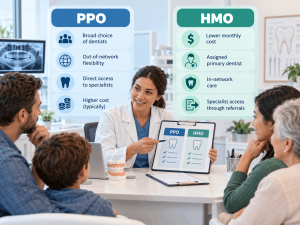
Both plan types help reduce the cost of dental care, but they do so through different mechanisms. A dental PPO (Preferred Provider Organization) negotiates discounted rates with a network of providers and shares costs with you via deductibles, copays, and annual maximums. The National Association of Dental Plans notes that PPO plans allow out-of-network access at reduced reimbursement, while HMO plans generally restrict coverage to their contracted network.
A dental HMO (Health Maintenance Organization)—sometimes called a DHMO or capitation plan—works differently. The insurer pays your assigned primary care dentist a fixed monthly fee per enrolled patient (capitation), and the dentist agrees to provide covered services with little or no copay. You must stay within the network and typically need a referral to see a specialist.
Head-to-Head Comparison
| Feature | Dental PPO | Dental HMO |
|---|---|---|
| Monthly premium | Higher | Lower to no premium |
| Annual deductible | Yes, typically $50–$150 | Usually none |
| Annual maximum benefit | Yes, typically $1,000–$2,000 | Usually none—covered services are defined |
| Dentist choice | Any licensed dentist; in-network for better rates | Must use assigned network dentist |
| Out-of-network access | Yes, at reduced reimbursement | Generally not covered |
| Specialist referrals | Can self-refer in-network | Must be referred by primary dentist |
| Preventive care | Often 100% in-network | Often $0 copay |
| Major work (crowns, root canals) | Shared cost after deductible | Low or fixed copay within network |
When a Dental PPO Is Likely the Better Fit
A PPO tends to work well when:
- You have an existing dentist you want to keep and they’re not in every HMO network
- You live in an area where dental HMO network coverage is thin
- You anticipate needing specialist care (orthodontics, periodontics, oral surgery) and want flexibility in choosing providers
- You travel frequently and need dental coverage outside one geographic area
- You’re comfortable paying higher premiums for broader access
PPO plans also tend to be easier to navigate if you already understand the dental care landscape. Our article on signs you’re overdue for a dental exam may help you assess how much care you actually need—which affects how much your plan structure matters.
When a Dental HMO May Be the Smarter Choice
An HMO is often a better fit when:
- Keeping monthly premiums low is the primary concern
- You mainly use preventive care—cleanings, exams, X-rays
- The HMO network in your area includes providers with strong reputations
- You’re comfortable being assigned a primary dentist and working within that structure
- You don’t anticipate needing significant specialist treatment in the near future
What About Orthodontic Coverage?
Orthodontic benefits are one area where the differences between plans become particularly visible. Many PPO plans include an orthodontic rider that provides a lifetime benefit (often $1,000–$2,000), subject to a waiting period. HMO plans vary considerably—some include orthodontic coverage with a fixed copay schedule; others don’t cover it at all or offer only limited discounts.
If orthodontic treatment is a consideration for you or a family member, verify what the plan specifically covers before enrolling. The treatment timelines involved—which can span one to three years—are covered in our article on how long orthodontic treatment usually takes, and that context can help you estimate total out-of-pocket exposure.
Specialist Access: A Key Practical Difference
One of the most consequential differences between the two plan types involves specialist referrals. Under a PPO, you can typically schedule directly with an in-network periodontist, endodontist, or oral surgeon without routing through your general dentist first. Under most HMO plans, you need your primary dentist to initiate a referral, and the specialist you’re referred to may be limited to those contracted with the plan. Our overview of how specialist referrals work in dentistry explains what that process involves in both scenarios.
The Missing Middle: Dental Indemnity and Discount Plans
It’s worth knowing two other options that exist outside the PPO/HMO binary. Dental indemnity plans reimburse a percentage of usual and customary fees with no network restrictions—they offer the most freedom but are increasingly rare and often expensive. Dental discount or savings plans (not insurance) provide reduced fees from member dentists in exchange for an annual membership fee. Discount plans can make sense for people who don’t qualify for traditional coverage or who face a gap between jobs.
Choosing Based on Your Actual Situation
The “right” plan is the one that matches your real usage pattern. If you see the dentist every six months for cleanings and rarely need anything beyond preventive care, an HMO’s lower premium structure may be the more efficient choice. If you have ongoing dental needs, existing provider relationships, or anticipated specialist care, a PPO’s flexibility typically justifies the added cost.
Before open enrollment closes, it helps to list your likely dental needs for the coming year, confirm whether your current dentist participates in each plan you’re comparing, and check specialist network depth in your area. That groundwork takes thirty minutes and often makes the decision clear.